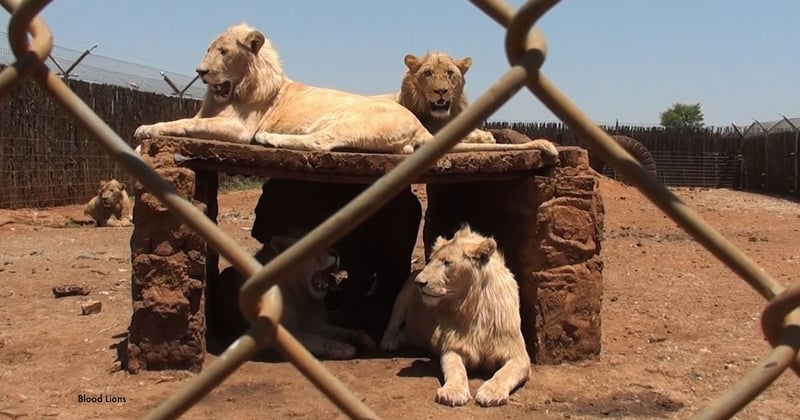
New International Poll: 70% of international tourists would be deterred if South Africa reverses captive lion industry phase-out.
Press release
Poll results warn of reputational damage, tourism losses, and economic risk if captive lion breeding industry is allowed to continue.
A new international poll commissioned by World Animal Protection in collaboration with Blood Lions reveals overwhelming opposition, both internationally and within South Africa to any reversal of the country’s planned phase-out of commercial captive lion breeding.
Although the South African government committed in 2021 to end the captive lion industry, progress toward implementing a concrete phase-out plan has been slow. With recent ministerial changes in the environment portfolio, concerns are growing that this landmark decision could be rolled back.
For years, South Africa has faced global criticism over captive lion breeding - particularly practices linked to canned hunting, cub petting tourism, and the export of lion skeletons.
The survey, conducted by Savanta across South Africa, the United Kingdom, the United States, the Netherlands and Germany (total of 2,528 respondents), found that three out of four (77%) respondents support the South African government’s 2021 decision to phase-out the commercial exploitation of captive lions.
Among four key international tourist markets visiting South Africa (see full report HERE):
- 70% stated that they would put off visiting a country that allows lions to be bred and kept in captivity for profit.
- 69% warned that reversing the phase-out would damage South Africa’s reputation as a responsible and ethical tourist destination.
- 77% believe the government should prioritize wildlife-friendly tourism over commercial captive lion breeding.
- 65% said they would choose alternative travel destinations if the industry continues.
The poll shows that concern for lion welfare remains a powerful motivator. Protecting these animals is not just ethical - it's what the public expects.
The world is watching how South Africa manages their natural heritage and tourists are making decisions accordingly.
Potential Economic Consequences
Tourism contributes nearly 9% to South Africa’s GDP and supports an estimated 1.8 million direct and indirect jobs. In 2025, South Africa received nearly 10.5 million international tourists, with the UK, USA, the Netherlands and Germany accounting for over 1.2 million arrivals.
If 70% of tourists from these markets were deterred from visiting, South Africa could lose an estimated 860,000 visitors. Given that tourism supports one job for every 13 international arrivals, this could translate to approximately 66,000 tourism jobs at risk1.
By comparison, the commercial captive lion industry is estimated to support a relatively small number of 1,568 to 2,069 jobs across South Africa.
Strong Domestic Opposition
South African citizens expressed similar concerns to international tourists from four key source markets:
- 72% reject promoting exploitative wildlife industries over wildlife-friendly tourism alternatives.
- 66% say commercial captive lion breeding is unethical.
- 66% believe it would be unacceptable to risk tourism demand.
- 63% warn that reversing the phase-out would undermine trust in evidence-based governance.
- 57% believe that banning captive lion breeding would make South Africa a more attractive destination and strengthen its economy.
Lion welfare emerged as the strongest reason for supporting the phase-out, cited by nearly half of the respondents who agree with the government’s 2021 decision.
South Africa’s commercial captive lion industry has been proven to be deeply problematic, creating issues around reputational damage, ethical and animal welfare concerns and zoonotic diseases.
Our new polling data shows that failing to end this industry also risks serious harm to our vital tourism industry.
We call on Minister Willem Aucamp to end the delays and uncertainty and urgently deliver the promised phase-out of this industry.
ENDS
Among the four key tourist markets, nearly 860,000 respondents (70% of 1,226,786 - the total number of international tourist arrivals in 2025 from the four key source markets, namely USA, UK, Germany and the Netherlands) stated that they would be deterred from visiting South Africa if the country continued the keeping and breeding lions in captivity for profit.
Notes to Editors
For more information:
Contact: Dr Louise de Waal - Blood lions
Email: management@bloodlions.org
Blood Lions is an award-winning documentary film and a registered non-profit organization that works to bring an end to predator breeding and canned hunting industries in South Africa.
Website: www.bloodlions.org
Or
Contact: Evans Kipkorir / Angela Stevenson - World Animal Protection
Email: evanskipkorir@worldanimalprotection.org / angelastevenson@worldanimalprotection.org
World Animal Protection is a global animal welfare organization with over seventy-five (75) years' experience in safeguarding the lives of animals around the world. Our vision is "A world where animals live free from cruelty and suffering." Our current work is in two strategic programme areas which are: Food Systems and Wildlife.
Website: www.worldanimalprotection.org
Latest news
-
Pink elephant photoshoot in Jaipur under investigation over animal...
News
A viral Jaipur photoshoot showing a captive elephant painted pink is under investigation amid concerns over animal welfare...
-
Poll warns South Africa against captive lion industry reversal
News
A new poll shows 70 percent of tourists would avoid South Africa if it reverses its captive lion...
-
China drops cruel macaque execution act after global outcry
News
A Chinese tourist site has halted a disturbing macaque execution performance after widespread public criticism and animal welfare...
-
China lion attack injuring child fuels push for safer...
News
An incident of a girl injured by lions at a China zoo has raised the risks of close...