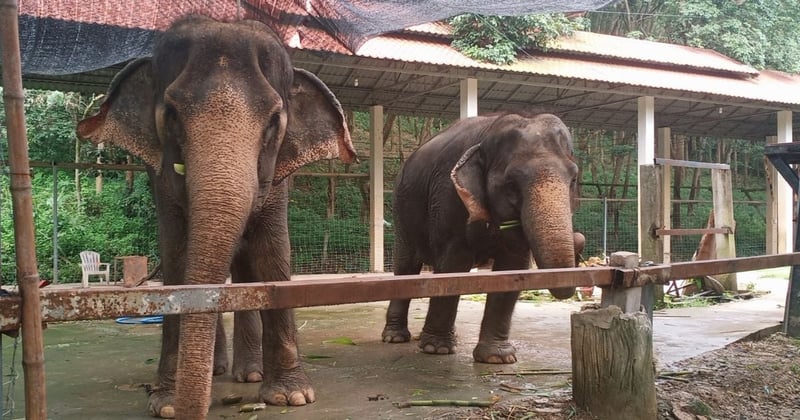
New report finds that two out of three captive elephants used in tourism live in poor conditions
Press release
Slight increase in elephant numbers despite growing awareness - and a troubling shift toward “ethical-looking” but harmful tourist activities
A new assessment by World Animal Protection has found that 69% of elephants used in the tourism industry in Thailand are still living in poor or unacceptable conditions.
The report, Bred to Entertain, examines the living conditions of 2,849 elephants across 236 tourism venues, a continuation of 15 years of research. It states that while there are some positive changes, most elephants continue to face poor conditions, involving tight restraints, cruel training, and little opportunity to express natural behaviour.
The assessment shows that across the venues assessed in Thailand:
- 69% of captive tourism elephants live in poor conditions.
- 26% live in 'improved' conditions.
- Only 5% live under 'best possible' captive conditions.
When tourists participate in activities that bring them in direct contact with elephants, they unwittingly sustain the cruel practices and the stress these animals endure in captivity.
The renowned expert has led this research since 2010, visited numerous elephant camps and authored several scientific publications on the elephant tourism industry.
Just as troubling for researchers is that the total number of elephants in the industry has increased by 3% since the organisation's last full assessment in 2019. A rise, experts had hoped, would go in the opposite direction following the global decline in tourism during the covid-19 pandemic and years of public campaigning.
We had hoped to see a significant decrease.
So, it's deeply disappointing to conclude the opposite: that despite growing awareness and some positive shifts, the overall number of elephants living in poor conditions has not yet declined.
Tourists turning away from riding - but toward a new problem
The report does highlight one positive trend: demand for elephant riding shows a clear downward shift. Fewer camps now offer riding activities, and the number of elephants used in circus-style shows has also declined significantly.
However, researchers warn that this reduction is overshadowed by a steep rise in activities marketed as ethical or hands-on learning experiences, such as elephant washing and caretaker-for-a-day experiences.
This shows that traveller awareness and changing expectations can reduce harmful practices, but it also highlights the need to guide demand toward genuinely elephant-friendly alternatives, to avoid it being redirected toward other forms of exploitation.
According to the latest assessment, 54% of elephants are now used in washing or caretaking activities, while only 7% live in camps where they are observed from a distance without physical contact - the option considered best for elephants.
Travellers seem to increasingly avoid elephant rides because they understand the harm inflicted on the animals.
Instead, they are turning to activities they believe are more ethical - like washing or caretaker-for-a-day activities.
In this they are being misled, as these activities require many of the same bad conditions and unacceptable practices, such as cruel training.
As calves, elephants are forcibly taken from their mothers and isolated from their families. They are then subjected to cruel training, intended to break their spirit and make them easier to control with tools such as bull hooks, sticks or spears.
Direct contact means cruel control
Researchers stress that any activity involving close contact with tourists requires strict control over elephants, which are powerful wild animals.
Every hands-on experience with a wild animal involves some level of restraint and control, which can be very stressful for the animal.
Even activities that look gentle or harmless, like washing an elephant, rely on control methods rooted in cruel training.
Incidents where elephants have injured tourists continue to occur. Either by accident or because the animal's patience is pushed beyond its limits. In early 2025, a 22-year-old Spanish tourist was killed during an elephant washing activity in Thailand - a stark reminder that these attractions pose risks to both animals and people.
Call for the travel industry to take responsibility
World Animal Protection is urging global travel companies to stop promoting or selling tickets to hands-on wildlife encounters. According to the organization, genuine elephant sanctuaries would never offer elephant riding or washing experiences.
Our experience shows that close collaboration with the travel industry is an effective way to help travellers make responsible choices. We therefore urge travel companies not to promote or sell tickets to hands-on activities with wildlife.
Genuine sanctuaries would never offer elephant riding as well as washing experiences. It is crucial for travellers and tourists to understand that activities based on direct interaction are never compatible with high welfare standards for elephants.
World Animal Protection works with travel companies and local stakeholders to support a shift toward observation-only experiences that prioritize elephant welfare while supporting livelihoods.
The organisation's 15-year dataset shows that awareness campaigns and industry engagement can change practices when clear guidance and alternatives are possible, but progress remains uneven and far too slow to protect most elephants currently used in tourism.
World Animal Protection also provides elephant-friendly guidelines to support venues in transitioning to best-practice animal management, while preventing further growth of the captive elephant population. These venues give elephants greater autonomy, more opportunities to express natural behaviours, and avoid direct contact with visitors.
Our latest research indicates a positive shift in travelers’ mindsets, but more is needed to enable a gradual phase out of the reliance on captive elephants in tourism - in collaboration with local communities.
The shift away from riding is really encouraging, but it must not be replaced by new forms of exploitation dressed up as ethical tourism.
ENDS
Notes to Editors
- A full copy of the research can be found here.
- For an interview with a World Animal Protection spokesperson, please contact Angela Stevenson: Angelastevenson@worldanimalprotection.org
Latest news
-
Poll warns South Africa against captive lion industry reversal
News
A new poll shows 70 percent of tourists would avoid South Africa if it reverses its captive lion...
-
China drops cruel macaque execution act after global outcry
News
A Chinese tourist site has halted a disturbing macaque execution performance after widespread public criticism and animal welfare...
-
China lion attack injuring child fuels push for safer...
News
An incident of a girl injured by lions at a China zoo has raised the risks of close...
-
Nicaragua’s rise in exotic animal trade threatens biodiversity
News
Over 11,000 wild animals were exported from Nicaragua in one month, raising concerns for welfare, biodiversity, and public...