Chicken meat imports must meet EU welfare standards
Press release
Eliminating double standards: chicken meat imports must meet EU welfare standards
Brussels, 14 October 2026 As the EU prepares to revise its welfare rules for chickens reared for meat, a new report from Eurogroup for Animals and World Animal Protection warns that the reform will stop at the border unless imports are covered too. Chicken meat from outside the EU currently only has to meet EU welfare standards at slaughter, not for how the birds are bred, reared and transported.
Today’s joint report – No Double Standards – shows the scale of chicken meat imports: 25% of EU chicken breast is imported, with just four countries (Brazil, Thailand, the UK and Ukraine) making up 88% of imports. Imports of chicken meat from these four countries in 2025 represented an estimated 274 million chickens, much of this from factory farms.
The report highlights the risk of a gap in welfare standards between EU chicken and the chickens imported into the bloc. The organisations call on the EU to stop this double standard and require chickens to have the same level of protection no matter their origin. Citizens agree: a poll across 18 EU Member States found that 73% of respondents support requiring imported chicken meat to meet the same or equivalent breeding and welfare standards as EU-produced chicken meat.
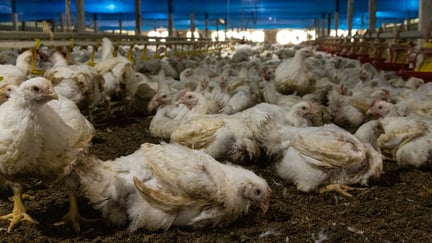
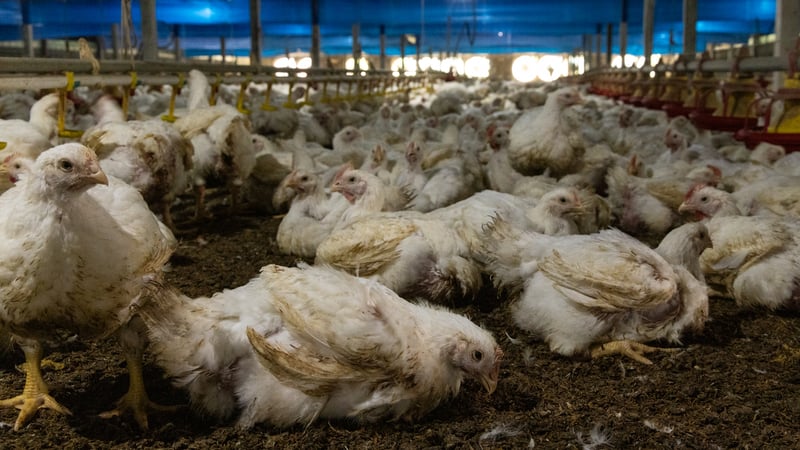
Major welfare issues for meat chickens, like prioritising fast growth and overcrowding (with each chicken living in an area smaller than a sheet of A4 paper), leading to serious health issues for the birds, are significant in the countries the EU imports from. Such issues also exist in the EU, as they are inherent to intensive farming systems that prioritise output numbers above all else.
The European Commission is expected to propose revised EU meat chicken rules by the end of 2026, and apply equivalent rules to imports. However, an import rule limited to cages would not close the chicken meat welfare gap because it leaves the main welfare risks in EU-produced and imported chicken supply chains largely unchanged.
The drive towards producing chicken meat as cheaply and quickly as possible has serious consequences for the animals and must not become a race to the bottom. The EU should come forward with a revised broiler directive that is separate from the laying hens proposal, and one that adequately improves the lives of chickens raised for meat, by reducing stocking densities and supporting higher welfare breeds. It is crucial that improved welfare standards also apply to imported products; this will not only avoid double standards for producers but is in line with consumers' demands.
Behind every kilogram of imported chicken meat are individual birds whose welfare matters. We cannot leave our responsibility at the border. If we are serious about protecting animal welfare, we must ensure high standards not only within the EU, but also for animals raised outside the EU whose products enter our market. Equivalent welfare standards are essential to prevent outsourcing animal suffering and to ensure that every chicken counts.
European farmers risk being put at a disadvantage by this import double standard. The report highlights that EU farmers who invest in better animal welfare and higher standards, such as slower growing breeds and less overcrowding, risk being undercut by cheaper, lower welfare imports.
Imported chicken is mostly invisible to the end consumer who is likely to eat it in a restaurant, as a take-away or a ready-meal. But it is clear the people want high welfare standards for the chicken they eat, whether it is reared here or imported: 96% of respondents to the Commission's public consultation fully agreed that equivalent standards should apply to imports.
The report calls on the EU to:
- Put forward a modernised meat chicken legislation that goes beyond banning cages, and a dedicated import-equivalence article in this meat chicken welfare law. This should cover all chicken products (fresh, frozen, processed, prepared) and all channels, including food service.
- Ensure equivalent protection in practice.The report does not demand identical legislation in those countries. And market access should be dependent on demonstrating and maintaining that equivalence through approval, certification, traceability, audits and suspension powers.
- Provide appropriate transition periods and technical support for exporting countries.
– ENDS –
Notes to editors
The full report can be found here.
Photo caption: Chicken production in Thailand. (World Animal Protection Sweden)
The polling data cited in the report:
- A poll across 18 EU Member States found that 73% of respondents support requiring imported chicken meat to meet the same or equivalent breeding and welfare standards as EU-produced chicken meat (Savanta. EFA-EU Animal Welfare Poll 2026).
- 96% of respondents to the Commission's public consultation fully agreed that equivalent standards should apply to imports (European Commission. On-farm Animal Welfare for Certain Animals: Modernisation of EU Legislation. (2026).
Note on Brazil imports and EU antimicrobial rules. Since 3 September 2026, Brazil has not been on the EU list of third countries authorised to export certain animal products, including poultry meat, to the EU. The Commission had not received sufficient guarantees that EU restrictions on antimicrobial use would be met throughout animals' lives. (Source: France 24).
World Animal Protection is the global voice for animal welfare, with more than 75 years of experience campaigning for a world where animals live free from cruelty and suffering.
We have offices in 12 countries and work across 47 countries. We collaborate with local communities, the private sector, civil society and governments to change animals’ lives for the better.
Eurogroup for Animals represents over one hundred animal protection organisations across Europe and worldwide. Since 1980, we have played a central role in advancing stronger animal welfare standards in the EU. Through our broad membership, we reflect public expectations and provide scientific and technical expertise to EU institutions. We are also a founding member of the World Federation for Animals, strengthening the movement’s voice globally.
Spokespeople are available for interview:
Roger Pettersson, CEO, World Animal Protection Sweden
Roatchana Sungthong, Thailand Country Director, World Animal Protection
Daniel Pérez Vega Farm Animals Senior Project Officer - Trade, Eurogroup for Animals
Press contacts
World Animal Protection:
Lisbeth Kjaer, Communications Director, World Animal Protection Denmark
Phone: +4526136935, Email: lisbethkjaer@worldanimalprotection.dk
Eurogroup For Animals:
Theresa Bonnici, Press Officer, Eurogroup for Animals