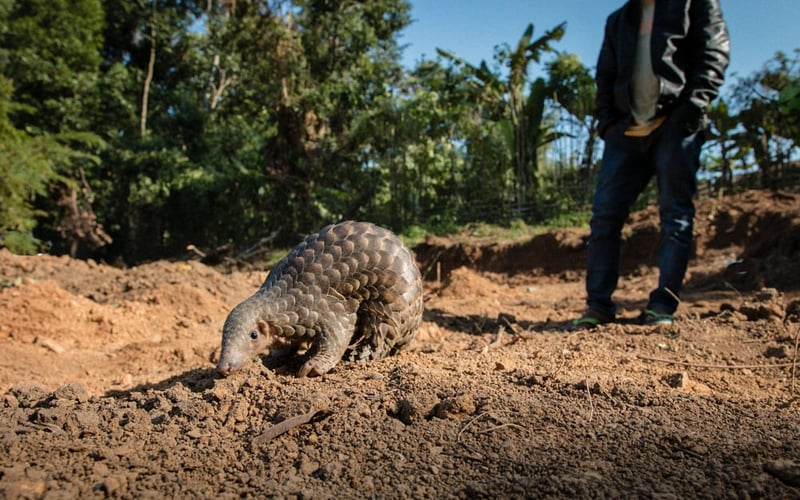
Pangolins are one of the most trafficked mammals in the world — and as pangolin habitats shrink and fragment, their survival is further threatened. To help save these animals, we must conserve pangolins’ natural habitats. And that starts with understanding where and how they live.
What is a pangolin’s habitat?
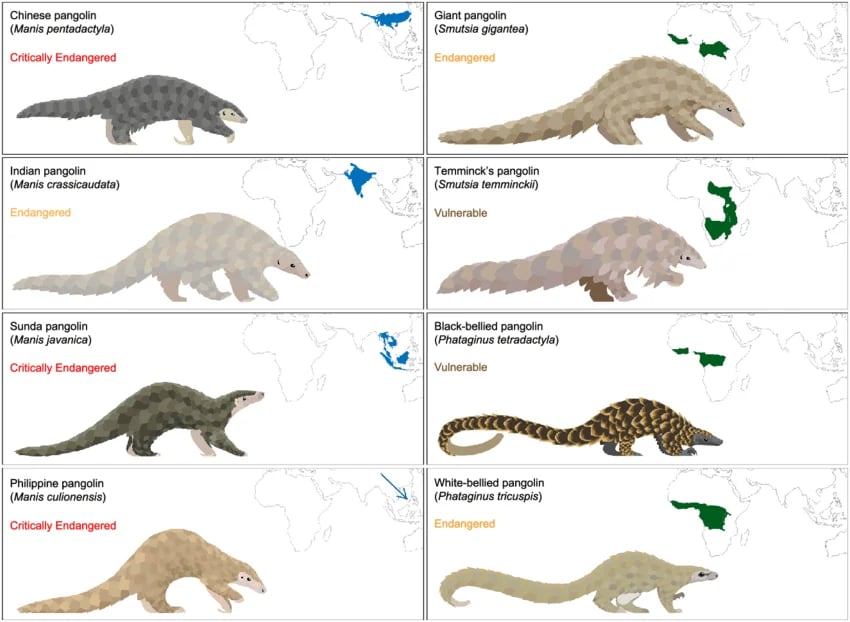
There are eight species of pangolin, four of which live in Asia (including the Chinese, Sunda, Philippine, and Indian pangolins) and four in Africa (including the African, ground, giant, and long-tailed pangolins).
Pangolin natural habitats vary by species but include tropical and flooded forests, thick brush, cleared and cultivated areas, and savannah grassland. Usually, they live where there are plenty of ants and termites.
Sadly, though, many pangolin habitats are threatened by deforestation, agricultural expansion, and infrastructure development. As more forests are cleared, pangolins are forced into smaller, fragmented habitats. This not only limits their access to food but also increases the risk of human contact, poaching, and exploitation.
Pangolin habitat map
The below pangolin habitat map highlights their range across Asia and Africa.
Chinese pangolin habitat
Despite what their name suggests, Chinese pangolins aren’t just found in China. They live across much of Asia, mainly in Nepal, Bhutan, northern and northeastern India, Bangladesh, Myanmar, Laos, Vietnam, Thailand, and Hong Kong, as well as southern China.
They are highly adaptable animals and usually live in hills and mountains at a range of altitudes. Chinese pangolin habitat includes tropical, bamboo, and limestone forests, as well as grasslands and agricultural land.
As ground-dwelling pangolins, they dig up to 10-metre deep burrows for shelter, protection, and sleep.
Sunda pangolin habitat
Sunda or Malayan pangolins are largely arboreal, meaning they live in trees and usually sleep in tree hollows, fallen logs, or burrows. That’s why they can usually be found in forests, mangroves, and riverine forests, as well as forests that have been converted into oil palm and rubber plantations.
Sunda pangolin habitat extends across mainland and island Southeast Asia. They can be found in central Myanmar, Thailand, the Lao People's Democratic Republic, Cambodia, Vietnam, Peninsular Malaysia, Singapore, Sumatra, Java, and Borneo.
Philippine pangolin habitat
As their name suggests, Philippine pangolins are native to the Philippines.
They live in the Palawan faunal region, including mainland Palawan, the Calamian Islands (including Culion, Busuanga, and Calauit), small islands off El Nido (including Lagen, Tagnipa, and Nagbilisong), and Apulit Island.
While Chinese pangolins are ground dwellers and Sunda pangolins are arboreal, Philippine pangolins are both. That means that Philippine pangolin habitats are varied. They can happily live in lowland forests, lowland grassland, logged-over forests, agricultural areas, coastal beach forests, mangroves, and riverine forests.
Indian pangolin habitat
The last Asian pangolin on our list, the Indian pangolin, is found across much of South Asia. Its range stretches from northern and southeastern Pakistan through most of India south of the Himalayas, as well as southern Nepal and Sri Lanka.
Indian pangolins are very adaptable. They spend much of their time in burrows, but they are also capable climbers and will scale trees. These adaptations allow them to live in tropical forests, grasslands, open scrub, and arid areas.
African pangolin habitat
Also known as white-bellied pangolins, African pangolins are found across sub-Saharan Africa.
- In West Africa, African pangolin habitats include Guinea-Bissau, Guinea, and Sierra Leone, as well as parts of West and Central Africa, Nigeria, Togo, and Benin.
- In Central Africa, they can be found in Cameroon, Equatorial Guinea and Bioko Island, Gabon, the Republic of the Congo, the Central African Republic, and the Democratic Republic of the Congo.
- In East Africa, the African pangolin habitat includes Uganda, Rwanda, Burundi, southwestern Kenya, and northwestern Tanzania.
- Further south, they have been spotted in northern Angola and parts of Zambia.
African pangolins are well adapted to both arboreal and terrestrial life. They mainly live in tropical lowland forests, but they can also be found in dense woodland near rivers and streams.
Because they are losing their pangolin natural habitat to deforestation and agricultural expansion, they sometimes also inhabit abandoned oil palm plantations, farmland, and other disturbed forest areas.
Ground pangolin habitat
Ground pangolins, also known as Temminck’s pangolins, are the most widespread African pangolin species. They live across much of eastern and southern Africa.
Their range extends from southeastern Chad and South Sudan through East Africa and into southern Africa, reaching as far south as the Northern Cape, North West, and northeastern KwaZulu-Natal provinces of South Africa. The western limits of their range include Namibia and southern Angola, while the northern boundary includes parts of the Central African Republic, Chad, and Ethiopia.
As their name suggests, ground pangolins are largely terrestrial (or ‘grounded’). They mainly inhabit savannas and woodlands in low-lying regions, though the ground pangolin habitat also includes floodplain grasslands, rocky slopes, and sandy areas.
Giant pangolin habitat
Giant pangolin habitats include rainforests, swamp forests, gallery forests, wooded savannahs, and agricultural mosaics across West and Central Africa.
Their range extends from Senegal eastwards through Guinea, Sierra Leone, Liberia, Côte d’Ivoire, Ghana, and parts of Nigeria.
- In West Africa, Giant pangolins can be found in Ghana’s protected Mole National Park.
- Further east, they live across Central Africa, from Cameroon through the Congo Basin, including the Central African Republic, Democratic Republic of the Congo, and into Uganda.
- Giant pangolins have also been spotted on the Uganda-Kenya border, in western Tanzania, in South Sudan, and in Rwanda’s Akagera National Park.
Long-tailed pangolin habitat
Long-tailed pangolins, also referred to as black-bellied pangolins, can be found in the forested regions of West and Central Africa. They are the most arboreal of the African pangolin species, sleeping in either tree hollows or abandoned insect nests.
They can be found in swamp forests and forests near water, as well as drier Guinean forests.
Their range extends from Sierra Leone eastwards through southeastern Guinea, Liberia, Côte d’Ivoire, southwestern Ghana, and western Nigeria. They can also be found in southern Cameroon and much of the Congo Basin, including parts of the Central African Republic, Democratic Republic of the Congo, Gabon, and the Republic of the Congo.
You can make a difference for vulnerable animals
Donate now
When you make a donation, you’ll join a passionate group of supporters who are determined to change the world for animals. We're fighting animal cruelty wherever we find it — are you with us?
Click to donatePangolin habitat loss
Pangolins' habitats are under threat because of mass deforestation. In Asia, their natural range is being lost to oil plantations and urban expansion, while in Africa (and West and Central Africa in particular), pangolin habitat loss is triggered by agricultural expansion, mining, quarrying, oil drilling, and logging operations.
This habitat loss not only makes it harder for pangolins to find food and shelter, but it leaves them even more vulnerable to other threats, too — including illegal poaching and trafficking.
As their habitat shrinks and becomes more fragmented, they are forced into smaller areas and pushed closer to human settlements, where hunters can more easily locate and capture them. They are then illegally sold as bushmeat or traded for their skin and scales for use in traditional medicine.
To help save the pangolins, we must save their habitat.
How to help protect pangolin habitats
We need your help protecting pangolins and their habitat.
At World Animal Protection, we’re calling for stronger laws to tackle illegal wildlife trade and promoting wildlife-friendly alternatives to pangolin scales in traditional medicine.
But you can help too by sharing facts about pangolins and the threats they face, including poaching and habitat loss. You can also donate today to support our efforts and help save the world’s most trafficked animal.
Related content
World Pangolin Day
Animal Awareness Days
World Pangolin Day is observed on the third Saturday of February every year to celebrate pangolins and their contribution to the planet's ecosystem.
What Are Pangolin Scales Used For?
Blog
Discover what pangolin scales are used for, why they’re traded, and the impact on pangolins. Learn the truth behind traditional medicine claims and wildlife trade.
Pangolins
Learn about pangolins, the world’s most trafficked mammal. Discover why pangolins are endangered, the threats they face, and how we can help protect them.