Did you know that pangolins are the only mammals with scales? This natural armour protects them from predators and pathogens. But they can’t protect them from their biggest threat — poachers — who illegally hunt and trade pangolin scales for use in traditional medicine. Find out more about what pangolin scales are used for and why huge numbers of pangolins are cruelly slaughtered every year to fuel the traditional medicine trade, despite these scales having no proven medicinal value.
What are pangolin scales?
All eight species of pangolins are covered in protective, overlapping plates made of keratin, the same protein found in human fingernails and hair. These are known as pangolin scales.
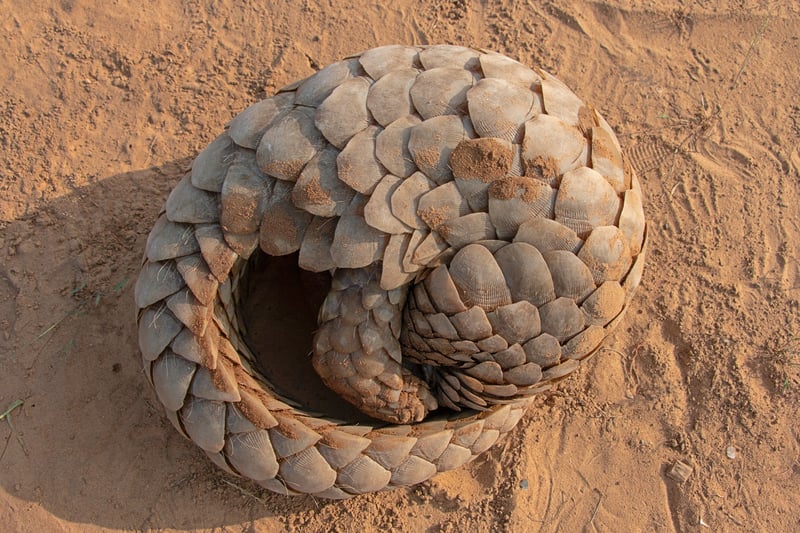
The scales on pangolins overlap like roof tiles and are part of a mighty defence system. Each one sits in the middle of six neighbouring scales, forming a hexagon pattern that lets the animal bend and move easily while still staying protected. They act as armour from predators and make up roughly 20% of the animal's weight.
How strong are pangolin scales?
Though they’re made of keratin, pangolin scales are surprisingly strong, largely due to their layered and interlocking structure.
Pangolin scales are strong, tough, and resistant to breaking. Their structure helps them absorb force and resist damage while still allowing the animal to move.
Interestingly, the strength of a pangolin’s scales is influenced by water. Dry scales are harder but more brittle, so they can crack easily. When hydrated, though, pangolin scales become softer and more flexible, which actually helps them resist breaking under stress.
Pangolin scales uses
In the wild, pangolins roll themselves into balls to protect their soft underbellies and present erect scales to an enemy. These serve as its natural armour, providing a strong barrier against the teeth and claws of predators such as leopards, lions, tigers, and hyenas.
In fact, the armour is so effective that scientists are studying pangolin scales in a bid to design more effective armour for humans.
Beyond this, their scales also help shield them from smaller-sized threats, including biting ants and termites (which make up much of their diet), as well as diseases. According to research, pangolin scales are also thought to trap and neutralise pathogens to help protect pangolins from illness.
What are pangolin scales used for in Chinese medicine?
In some traditional medicine systems, particularly in China and Vietnam, pangolin scales are incorrectly believed to treat ailments like rheumatism, skin conditions, lactation issues, weight loss, and vascular disease.
At World Animal Protection, we’re working to promote synthetic alternatives to these traditional medicines that are not only widely available but also mitigate the need for unethical and illegal pangolin products.
In 2020, we launched the 'Traditional Chinese Medicine Alternatives to Wild Animal Preparations' based on research with experts in traditional Chinese medicine to give practitioners and consumers a tool to easily identify more sustainable and mostly non-wildlife-based alternatives.
Do pangolin scales have medicinal properties?
As mentioned earlier, pangolin scales are made from keratin — the same material found in human hair and fingernails. Despite being used in some traditional medicine systems, there is no scientific evidence in modern medicine that pangolin scales have therapeutic or health benefits.
China has taken steps to reduce their use, but has not enacted a complete ban. In 2020, pangolin scales as a raw ingredient were removed from the traditional medicine pharmacopoeia (China’s official standard for clinical prescriptions). In 2025, China also removed Guilingji, a traditional medicine containing pangolin ingredients, from the latest edition of the pharmacopoeia.
While these decisions make pangolin-based medicines harder to promote and prescribe, companies may still be able to produce and sell them. Though these are steps in the right direction, pangolins are still under threat from ongoing demand.
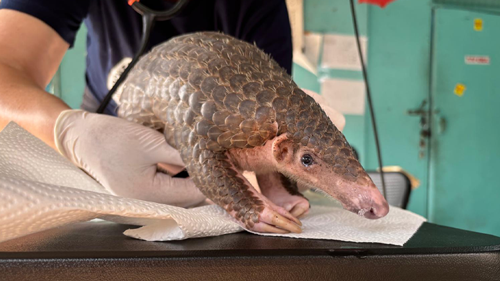
You can make a difference for vulnerable animals
Donate now
When you make a donation, you’ll join a passionate group of supporters who are determined to change the world for animals. We're fighting animal cruelty wherever we find it — are you with us?
Click to donateHow the pangolin scale trade impacts pangolins
Targeted for their scales, pangolins are one of the most illegally traded mammals in the world.
Between 2000 and 2013, it’s thought that an estimated one million pangolins were killed and traded — and that number has increased exponentially as the illegal trade has expanded globally. In Africa alone, it’s believed as many as 8.5 million pangolins met the same fate between 2014 and 2021.
This is a global problem. As Asian pangolin populations have been heavily depleted by illegal trade, hunters are increasingly targeting African pangolins to meet demand. Today, all eight pangolin species are listed as vulnerable, endangered, or critically endangered, and their numbers continue to decline.
How are pangolin scales removed?
Not only is the trade in pangolins illegal, but it’s also highly unethical and causes considerable harm and suffering.
The brutal process of removing pangolin scales is a prime example of the cruelty of the pangolin scale trade. According to footage of pangolin poaching, hunters first force the pangolin out of hiding by cutting down its shelter or smoking it out with fire. Once captured, the pangolin is repeatedly bludgeoned with a machete until it can barely move. While bleeding and often still alive, it is then thrown into a cauldron of boiling water to loosen the scales so they can be easily removed from the body and later sold for use in traditional medicine.
At World Animal Protection, we’re calling for a global end to the commercial wildlife trade to help protect pangolins and ensure their survival in the wild.
How to help protect pangolins
Here at World Animal Protection, we’ve been working to end the exploitation of animals for traditional medicine by promoting plant-based alternatives and influencing policy change.
You too can help us protect pangolins and their future by:
- Raising awareness and sharing facts about pangolins and their sentience
- Supporting efforts to end demand for pangolin scales in traditional medicine
- Calling for stronger laws to tackle illegal wildlife trade and protect pangolins
- Choosing wildlife-friendly alternatives and avoiding products linked to exploitation
You can also support our work at World Animal Protection by donating today. Your support helps fund campaigns, advocacy, and solutions that protect pangolins worldwide.
FAQs
What are pangolin scales made of?
Pangolin scales are made of keratin, the same protein found in human fingernails and hair, as well as lion claws and rhino horns.
Do pangolin scales grow back?
Just like hair and nails, pangolin scales never stop growing but are instead continuously replaced. They are naturally worn down as pangolins dig burrows and tunnel through the soil in search of termites and ants.
How many scales does a pangolin have?
Different pangolin species have different numbers of scales. A recent study found that the Temminck’s ground pangolin has the fewest number of scales, averaging 382 scales, while the Philippine pangolin has the most, at 940 scales on average.
Related content
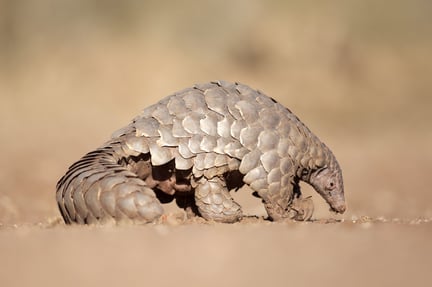
Pangolins
Learn about pangolins, the world’s most trafficked mammal. Discover why pangolins are endangered, the threats they face, and how we can help protect them.
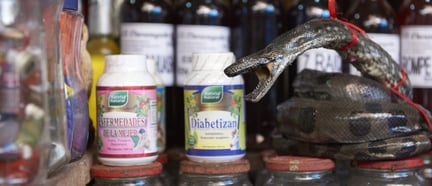
Traditional medicine
Ending commercial exploitation
Ending the exploitation of wild animals used in Traditional Medicine
No Future for Factory farming
Food systems
Factory farming is a global problem, that requires a global solution. A moratorium on factory farms is urgently needed to safeguard animals, our climate, health and the environment.