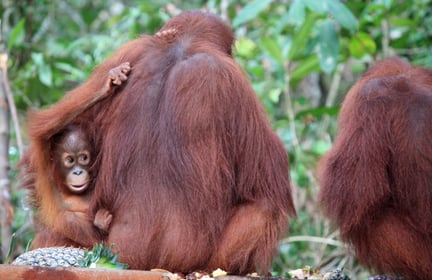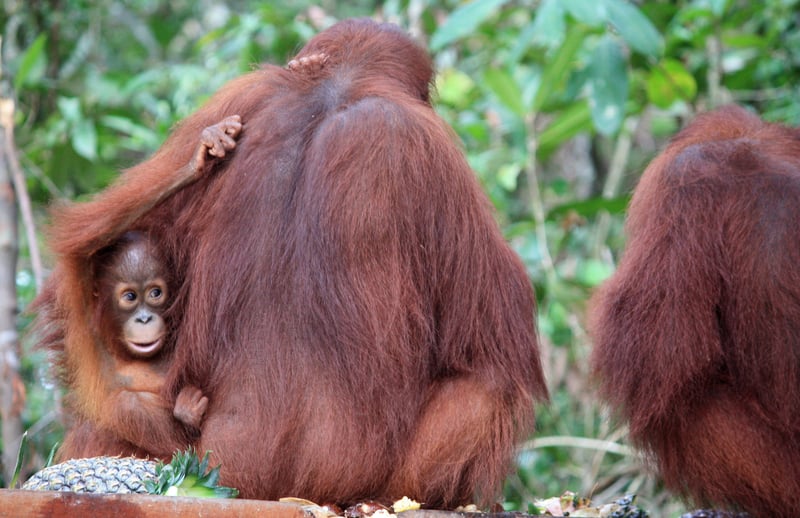
You’ve probably seen images of female orangutans, high in the Sumatran or Bornean rainforest canopy, an infant clinging to their sides. This is one of the most devoted relationships in the animal kingdom.
Female orangutans raise their young alone. They teach and care for their offspring across a whole decade, the longest period of maternal care seen in any mammal apart from humans.
These “people of the forest” are intelligent, sentient beings. And this mother-infant bond is crucial to the survival of the species.
You can discover more about orangutans and their family dynamics below.
The female orangutan
Female orangutans are some of the most attentive mothers on the planet.
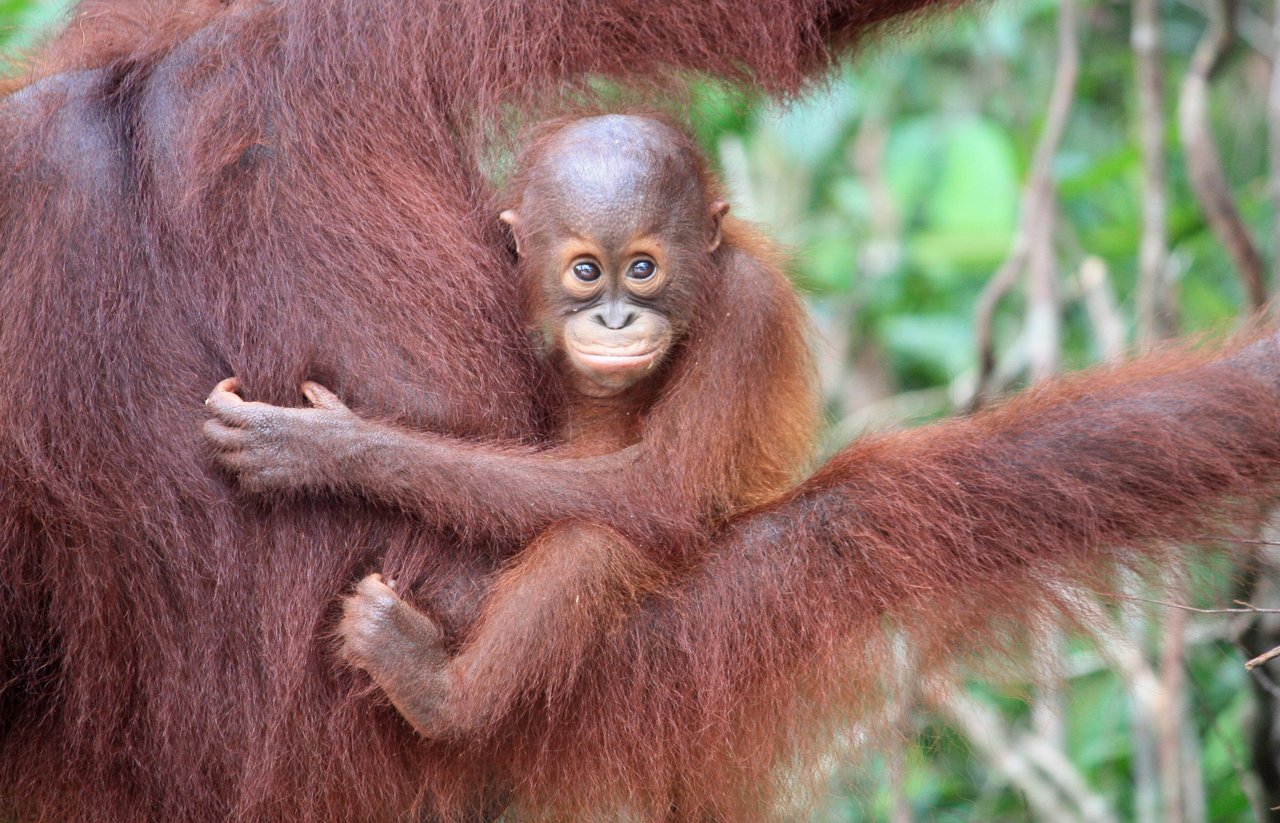
They keep their babies close, particularly in the first few years when mother and infant are in near-constant body contact. They nurse their young for up to eight years and share nests with their infants until they’re weaned.
Female orangutans are excellent teachers. They tailor their foraging to their infant’s age and ability. As time goes on, they share less food with their young to encourage independence, while continuing to share complex foods that are hard for young orangutans to find and process.
Mothers also have their own parenting styles and pass their personalities down to their children. Anxious orangutan mothers tend to produce cautious offspring, while adventurous mothers tend to produce curious, exploratory offspring.
The male orangutan
The male orangutan isn’t the most doting father. He leaves all childcare to the mother and has no contact with his infant at all.
Males are largely solitary and usually move through the forest alone. But that doesn’t mean they’re completely isolated from other orangutans.
The male orangutan’s long calls carry for over a kilometre through the forest canopy. These calls are a form of deliberate communication. They signal his identity, his social status, and even his direction of travel.
Male orangutans are also forward planners. They’ve been known to broadcast their travel plans a day in advance, so others can decide whether to approach or avoid them.
The young orangutan
Young orangutans spend their childhoods with their mothers, learning about life in the forest.
They learn to recognise and process over 200 different foods. This involves learning to use tools. For example, using sticks to scoop honey and insects from tree holes. They also watch their mothers building nests before practising this skill for themselves.
Young orangutans move around independently of their mothers by the age of five or six, but they stay close by, travelling with their mothers, and eating and resting in the same trees. They’re only fully independent by the age of 7 or 8.
And the bond doesn’t end there. Orangutan daughters sometimes continue to visit their mothers until they’re around 15 or 16, showing a deep attachment to their closest family member.
Daughters tend to establish territories that overlap with those of their mothers. And they’re much more likely to associate with their mothers and subsequent siblings than with unrelated females.
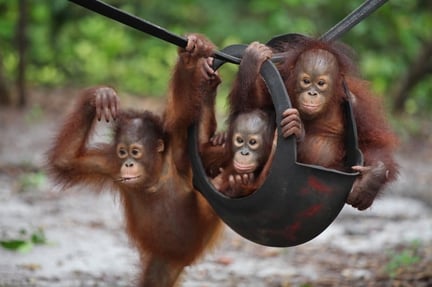
Despite their age gap, siblings sometimes play together. There’s even been a published case of an orangutan female adopting her younger sister after their mother went missing.
The risks facing orangutan families
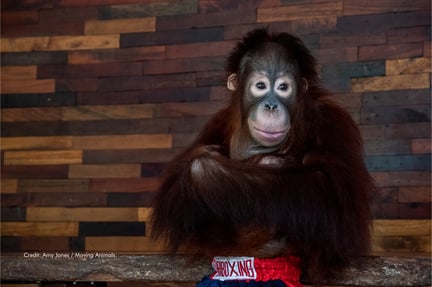
Orangutans are threatened by habitat destruction. The exotic pet trade and the sourcing of young orangutans for zoos and wildlife attractions are also tearing orangutan families apart.
Between 2005 and 2011, around 1,800 great apes were trafficked from the wild. Most of these were orangutans or chimpanzees.
And this figure doesn’t reflect the full scale of the problem. Orangutan mothers are killed so poachers can snatch their infants. Many infants die in captivity or during transit. Between 2 and 11 orangutans die for every one that reaches the pet market.
The 7 to 8 year interval between orangutan births means populations can’t recover quickly from these losses, and all three orangutan species are critically endangered.
Every orangutan lost is an individual. A child that has spent years bonding with and learning from its mother. A mother with invaluable survival skills that can be passed on to her young.
World Animal Protection is working to end the commercial exploitation of animals, protect orangutan habitat, and hold the industries responsible for these threats to account.
Want to support our campaigns? Donate to help orangutans today.
You can make a difference for vulnerable animals
Donate now
When you make a donation, you’ll join a passionate group of supporters who are determined to change the world for animals. We're fighting animal cruelty wherever we find it — are you with us?
Click to donateThree facts about orangutan family life
What is a group of orangutans called?
A group of orangutans is called a congress, or sometimes a buffet. But a gathering of orangutans is rare. Orangutans are semi-solitary and don’t tend to live in groups.
That being said, orangutans do occasionally gather together. This is usually at large fruiting trees, where there’s a lot of food available. However, in these cases, orangutans arrive and leave independently.
How often do female orangutans give birth?
Female orangutans typically give birth once every seven to eight years. It’s the longest interbirth interval of any mammal on Earth.
How many babies can a female orangutan expect to carry in a lifetime?
In the wild, female orangutans can live into their fifties. They reach reproductive age at around the age of 15.
Because of the long interbirth interval, and because orangutans almost always give birth to just one baby at a time, orangutan mothers usually devote their care to just four to five infants over the course of their lives.
When do young orangutans leave their mother?
Young orangutans leave their mothers at around 7 to 8 years old. This is the longest childhood bond of any mammal, other than humans. Daughters sometimes continue to visit their mothers until they’re around 15 or 16.
Related content
Bred for Profit Report
Explore the impact of Global Wildlife Farming: exploitation, risks, and urgent calls for change
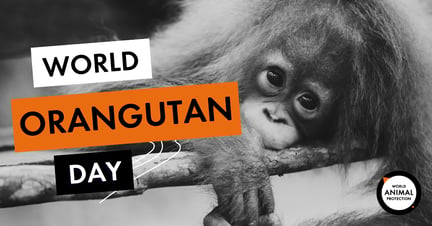
World Orangutan Day
Animal awareness days
Held on August 19th, World Orangutan Day is the perfect time to learn more about these great apes, their lives in the wild, and the threats they face.
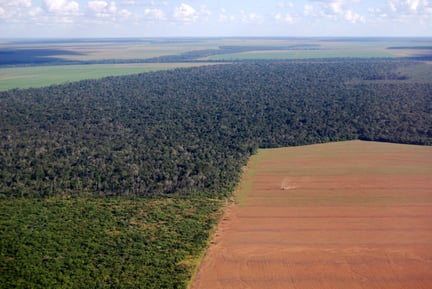
Habitat Loss & Destruction
Wildlife
Discover the causes and impacts of habitat loss, explore real-world examples, and learn how to protect and restore vital wildlife habitats worldwide.