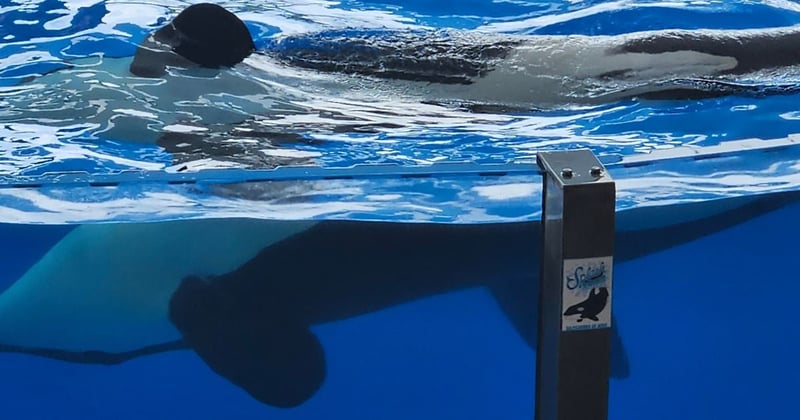
Plans to ship Marineland Orcas to Spanish Zoo branded ‘irresponsible’ by animal welfare NGOs
Press release
A worrying development has emerged for Wikie and Keijo, the two remaining orcas at the now-closed Marineland Antibes.
Reports published today indicate that plans may be under way to transfer the animals to Tenerife's notorious entertainment venue, Loro Parque, before the end of June.
It remains unclear whether Spanish authorities have authorised the move which would reverse their earlier position that Spain does not possess adequate facilities for these animals.
The park's management announced this today following a visit from French minister Mathieu Lefèvre. The news has not yet been officially confirmed by the French government. Animal welfare organisation World Animal Protection has called the potential move 'an incredibly disappointing step'.
The facility has seen the deaths of four orcas since 2021 and was deemed previously unsuitable by Spain's scientific authority under CITES, which reportedly stated it 'did not meet minimum standards in terms of area, volume and depth' for the marine mammals.
Wikie and Keijo's Plight
The future of the orcas has been uncertain since their current home, Marineland Antibes, closed in January 2025 following legislation to phase out the use of wild animals in circuses and marine parks. This includes a ban on the display and breeding of captive dolphins in France. Existing facilities were given until December 2026 to rehome their whales and dolphins.
It was hoped that the orcas would be relocated to a seaside sanctuary in Canada, offering a more natural and humane environment. However, this is still under development and requires more time.
A Systematic Failure
Wikie and Keijo have been failed at every stage by those that have profited from their captivity:
Parques Reunidos, the multi-billion euro company that acquired Marineland in 2006 should have taken responsibility for their care until a sanctuary solution was viable.
The French government put in place important legislation towards ending captive cetacean entertainment but failed to anticipate the need to provide solutions and has failed to support organisations working towards ethical alternatives, ultimately bowing to pressure from the captive industry and undermining the spirit of its own legislation to end this practice.
Travel industry giants such as TUI Group continue to drive the captive cetacean industry, promoting venues like Loro Parque, which actively breed orcas into captivity, perpetuating a problem which others are working hard to find solutions for.
Breeding at Loro Parque
Orcas are highly intelligent, social predators with complex family structures. It is widely recognised they cannot thrive in captivity.
Following global public outcry after the documentary Blackfish, SeaWorld announced it would end orca breeding.
Despite the obvious welfare issues for captive orcas, a Loro Parque spokesperson stated at an orca symposium in February 2025 that the park has no plans to stop breeding. Their most recent calf, Teno, who turned one on the 31st March, faces many years in captivity.
Teno was born to Morgan, an orca rescued off the Netherlands' coast in 2010 with the intention of rehabilitation and release. Instead, she was controversially transferred to Loro Parque, where she has since been used for performances and breeding.
Teno has now been introduced to adult males Tekoa and Adan. Introducing Marineland orcas Wikie (23) and her 11 year old son Keijo into this fragile and complex group is widely considered irresponsible and potentially dangerous.
If the intent of the French legislation is to be upheld, Wikie and Keijo should not be used for breeding or performances. However, there are serious concerns that this will not be respected at Loro Parque.
Today, 55 orcas remain in marine parks worldwide. In Europe, just six remain in captivity - with the addition of Wikie and Keijo, all captive orcas in Europe will now be held at Loro Parque.
Teno has only recently been introduced to Tekoa and Adan, the two adult males at Loro Parque. It is unprofessional and irresponsible to now bring another two orcas into the mix. Adding Wikie and Keijo will further destabilise the already fragile group at Loro Parque and likely lead to significant stress or aggression, with a young calf in the midst.
Loro Parque was already far from adequate for the current three adult orcas and a calf. Adding two new adult orcas will significantly worsen the situation and lead to suffering.
This is an incredibly disappointing move for these orcas.
We urge the French Ministry, who have been trying to find a solution for these orcas, to do all that they can to ensure that the intent of their legislation is followed and Wikie and Keijo are not used for breeding purposes. It is already tragic that these animals continue to face a lifetime in a tiny barren tank performing for tourists, let alone be used to perpetuate this cruel industry.
It is more important than ever to make this the last generation of whales and dolphins in captivity.
The Role of the Travel Industry
As public awareness grows, governments and companies are increasingly withdrawing support from captive whale and dolphin entertainment. Countries including France Belgium, Canada and Mexico have introduced bans.
However, Loro Parque continues to breed orcas and bottlenose dolphins, prolonging the cycle of captivity.
As one of the world's largest tour operators, TUI Group plays a significant role in promoting such venues. Despite updating its animal welfare policy in November 2024 to state that it would not sell experiences involving the commercial breeding of whales and dolphins, TUI continues to sell tickets to Loro Parque and similar attractions.
In November 2025, in response to ongoing criticism, TUI further amended its policy to define 'commercial breeding' narrowly as breeding for sale. Ignoring the significant financial benefits generated by captive born animals through increased visitor numbers, merchandise and continued performances.
World Animal Protection is calling on supporters to boycott TUI until it stops selling and promoting captive whale and dolphin entertainment. Find out more here.
Ends
Notes to Editor
- For further information please contact emilycunningham@worldanimalprotection.org.uk
- Images of orcas at Loro Parque here.
- Read World Animal Protection's Stories of Suffering report uncovering the stories of the dolphins suffering at TUI sold venues
- Travel companies that have stopped selling captive cetacean venues:
- In March 2024 easyJet holidays announced a strong animal welfare policy that means they will not sell tickets to any captive wildlife attractions including captive cetacean venues. Closely followed by Jet2holidays which announced in the same month that it will no longer sell tickets to captive dolphin venues
- Virgin Holidays, Expedia Group, Booking.com and Tripadvisor have all long since cut ties with this cruel and exploitative industry.
- Mexico, Canada, France, Belgium and New South Wales have all brought in bans on the keeping of whales and dolphins in captivity in the last six years.
- Dutch travel association ANVR and South Africa's SATSA state that captive cetacean entertainment is unacceptable in their guidelines for their member organisations.
- Strict regulations in the UK mean there have been no cetaceans in captivity for over 30 years.
- In October 2025 German based DERTOUR Group stopped selling tickets to captive whale and dolphin venues, stating on their website that 'experiences that involve direct contact with marine mammals or encourage unnatural behaviours no longer align with the values we want to uphold.'
About World Animal Protection
World Animal Protection is the global voice for animal welfare, with more than 75 years' experience campaigning for a world where animals live free from cruelty and suffering. We have offices in 12 countries and work across 47 countries. We collaborate with local communities, the private sector, civil society and governments to change animals' lives for the better.
Latest news
-
Chicken meat imports must meet EU welfare standards
Press release
As the EU revises welfare rules, a new report highlights risk of gap in welfare standards between EU...
-

Nepal Floods and the impact on animals and communities
News
World Animal Protection responds to the devastating Nepal floods, addressing the toll on animals and the disaster's link...
-
Victory! World's First Octopus Farm Plans Scrapped
News
Plans for the world's first commercial octopus farm have been abandoned after years of sustained pressure from NGOs,...
-
825 Dolphins and Whales Killed in Faroe Islands Hunts
News
825 dolphins and whales killed in Faroe Islands hunts in May, reigniting the call to end dolphin and...