Rescued macaques Jono and Unyil take their first steps into the wild after years in captivity in Indonesia’s dancing monkey trade
New footage shared by Jakarta Animal Aid Network (JAAN) documents the poignant moment of two former “dancing monkeys”, Jono and Unyil, step back into the wild.
The long-tailed macaques are among 46 rescued monkeys released on April 21st onto a protected Indonesian island, marking the end of years of suffering in captivity.
Once forced to perform for tourists in Indonesia’s dancing monkey trade, the animals are now beginning a new life in a safe, natural habitat.
First steps into freedom
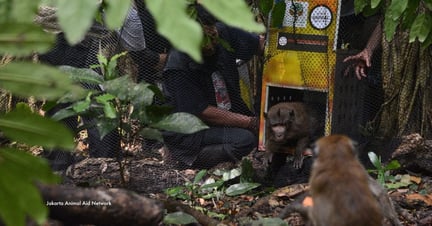
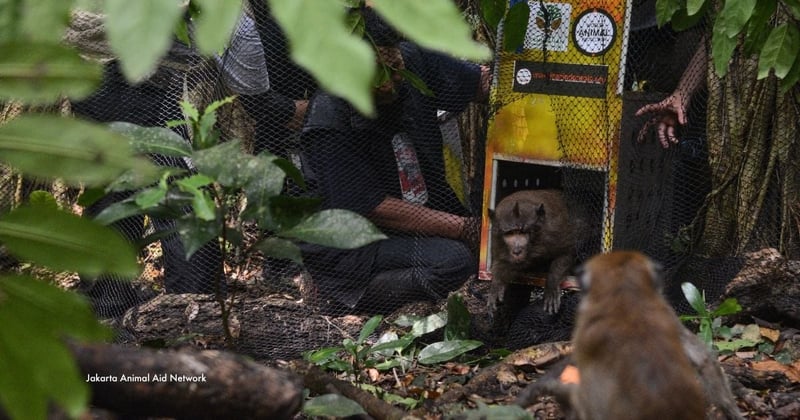
The footage documents the contrasting personalities of the two young macaques as they leave their transport crates behind.
Jono, aged seven, wasted no time. Within moments of the door opening, he disappeared into the dense forest, quickly putting distance between himself and the crate.
Unyil, just three years old, took a more cautious route. He pausesd, scanned his surroundings, and carefully made his way towards the trees, briefly glancing back before moving forward.
In the hours that followed, both began to settle. Jono was later seen spending time alongside other macaques, while Unyil was filmed foraging, clutching fruit he has found himself.
Preparing for life in the wild
The release site lies around 38 kilometres off Java’s coast, and has been designated as a protected habitat in collaboration with the Indonesian Government. With no permanent human presence and a mix of forest ecosystems, it provides a rare safe haven.
Before being fully released, the macaques spent time in a secure forest enclosure designed to help them readjust gradually. This transitional space allows them to become familiar with natural surroundings while still under observation.
Researchers from JAAN are continuing to track their progress, ensuring the animals are feeding independently and adapting to their new environment. Monitoring will continue as they expand their range across the island.
The journey to reach the release site was a significant logistical challenge. Rescue teams transported the animals by boat and on foot, trekking four kilometres through dense jungle, each carrying a crate on their back.
You can make a difference for vulnerable animals
Donate now
When you make a donation, you’ll join a passionate group of supporters who are determined to change the world for animals. We're fighting animal cruelty wherever we find it — are you with us?
Click to donateRescued from cruelty
The group of monkeys were rescued in October 2024 from a notorious training centre in Cirebon, the last of its kind in Indonesia.
Facilities like this subjected monkeys to harsh and often violent methods to force them into performing for crowds. When not working, the animals were typically restrained or confined in cramped spaces.
Jono and Unyil were kept close enough to see each other, but were unable to interact.
After their rescue, the macaques underwent 18 months of rehabilitation, receiving veterinary treatment and relearning natural behaviours critical for survival in the wild.
Stories of captive suffering
Jono and Unyil are among thousands of macaques caught up in Indonesia’s dancing monkey trade, where young animals are taken from the wild and forced into exploitation for tourists.
Many are captured as babies, often after their mothers are killed, before being subjected to harsh training methods to make them perform unnatural behaviours. Outside of performances, they are frequently chained or confined in small spaces, with little social contact or stimulation.
Jono, now seven, spent years carrying out physically demanding tricks such as walking on stilts and riding bicycles. Like many monkeys used in the trade, his teeth had been cut to prevent biting, causing severe pain and long-term infection.
Unyil’s early life followed a similar path. Taken from his mother as an infant, he was forced into training and kept in captivity for over a year. When rescued, he was underweight, fearful of people and unable to interact with other monkeys.
Their experiences reflect the wider reality of the trade, where prolonged confinement, poor diets and a lack of enrichment lead to both physical and psychological harm.
Wildlife tourism remains an issue
While the closure of the Cirebon training centre marks progress, the exploitation of macaques in Indonesia has not been fully eradicated.
Jono and Unyil will finally be able to live their lives where they belong, in the wild, with their new family.
Our partners Jakarta Animal Aid Network (JAAN) and local authorities have made great progress in stamping out the dancing monkey trade across much of Indonesia over the last 15 years.
Sadly, macaques continue to be widely exploited for tourism. We look forward to the day when we can celebrate a nationwide ban on dancing monkeys.
We will continue to call for an end to the exploitation of wild animals in entertainment and tourism.
Wild animals are sentient beings with complex needs that are extremely difficult to meet in captivity. Yet within the wildlife trade, their welfare is too often overlooked in favour of profit.
Travellers have a role to play in changing this. Avoid attractions that rely on captive animals for entertainment, including venues that promote captive breeding or showcase animals performing unnatural behaviours.
Before booking, take time to research and look out for signs of exploitation. Seek out ethical alternatives, including organisations and travel companies that have committed to wildlife-friendly practices and higher welfare standards.
Jono and Unyil are a result of tourist demand. They are among the few who are given a second chance and the chance to live freely again.
Related content

Can You See Bali Animals Ethically?
Blog
Before booking any Bali holiday packages where you meet native wildlife, read this guide on choosing ethical experiences that don’t harm Bali animals.
Which rescued monkey are you? Take the quiz!
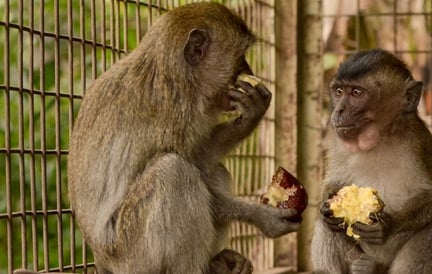
Which rescued monkey are you? Take our quiz to meet your macaque personality match and discover the rescue stories behind each monkey.
Monkey Abuse: The Cruelty Behind Cute TikTok Videos
Blog
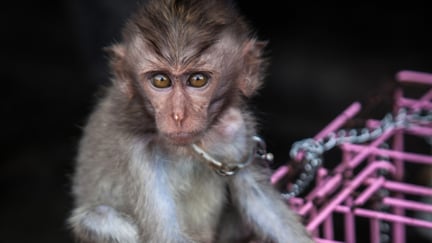
Discover the cruel truth behind cute macaque monkey videos on social media, and find out what you can do to stop this abuse.