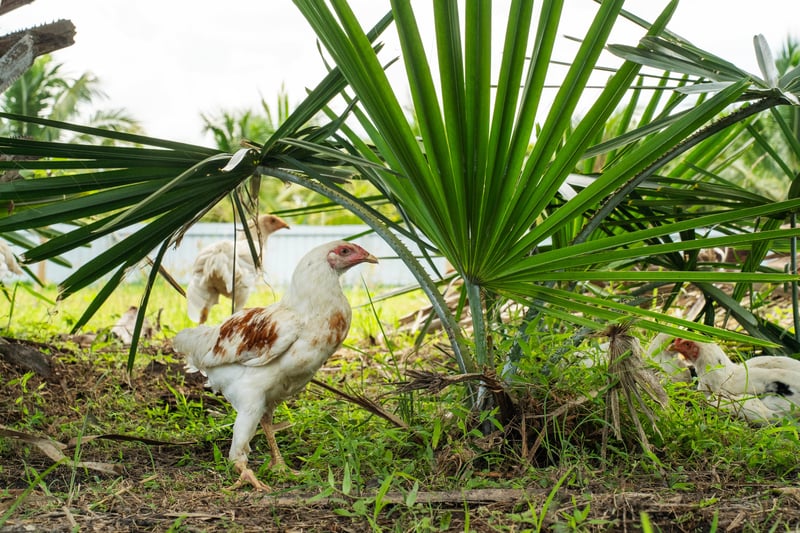
How the “Kai Suk Jai” Standard is Improving Chicken Welfare in Thailand
Blog
Finding out where your food comes from and the kind of life a farmed animal has lived isn’t always easy.
But a group of farmers in Nakhon Ratchasima and Surin provinces in lower northeastern Thailand are trying to change that.
They’re telling consumers exactly where their food has come from, while ensuring higher welfare standards for the chickens in their care.
Working with Patom Organic Living (Patom for short), under the Healthy Chicken Thailand project, farmers are building an animal welfare system of their own.
This Participatory Guarantee System (PGS) is written by the farmers themselves. And it’s called “Kai Suk Jai”, which roughly translates to “Happy Chicken”.
What is a PGS?
A PGS is a local quality assurance system. Managed by farmers, consumers, and local stakeholders, members of the PGS verify and certify one another, rather than relying on third-party certification.
Compared with third-party certification systems, a PGS has a number of benefits:
- Third-party certification is expensive. A PGS is a low-cost alternative. It makes certification much more accessible to poorer small-scale farmers.
- Third-party certification doesn’t always reflect the realities of small-scale farming. The local nature of a PGS means relevant standards can be developed, suited to the context, geography, and needs of its members and animals.
- Third-party certification can be overly rigid. The PGS approach is flexible. It’s seen as a shared learning process, with standards evolving over time, and a focus on learning rather than punishment.
Participatory Guarantee Systems have been used in organic farming circles across the world for over 40 years. They’re systems built on community trust, participation, and knowledge-sharing.
How was the Kai Suk Jai PGS developed?
Kai Suk Jai is a shared framework.
It ensures that every farmer in the PGS understands what is meant by animal welfare. They don’t have to rely on their own knowledge or copy their peers.
The PGS creates a path toward better chicken welfare that local farmers can walk together.
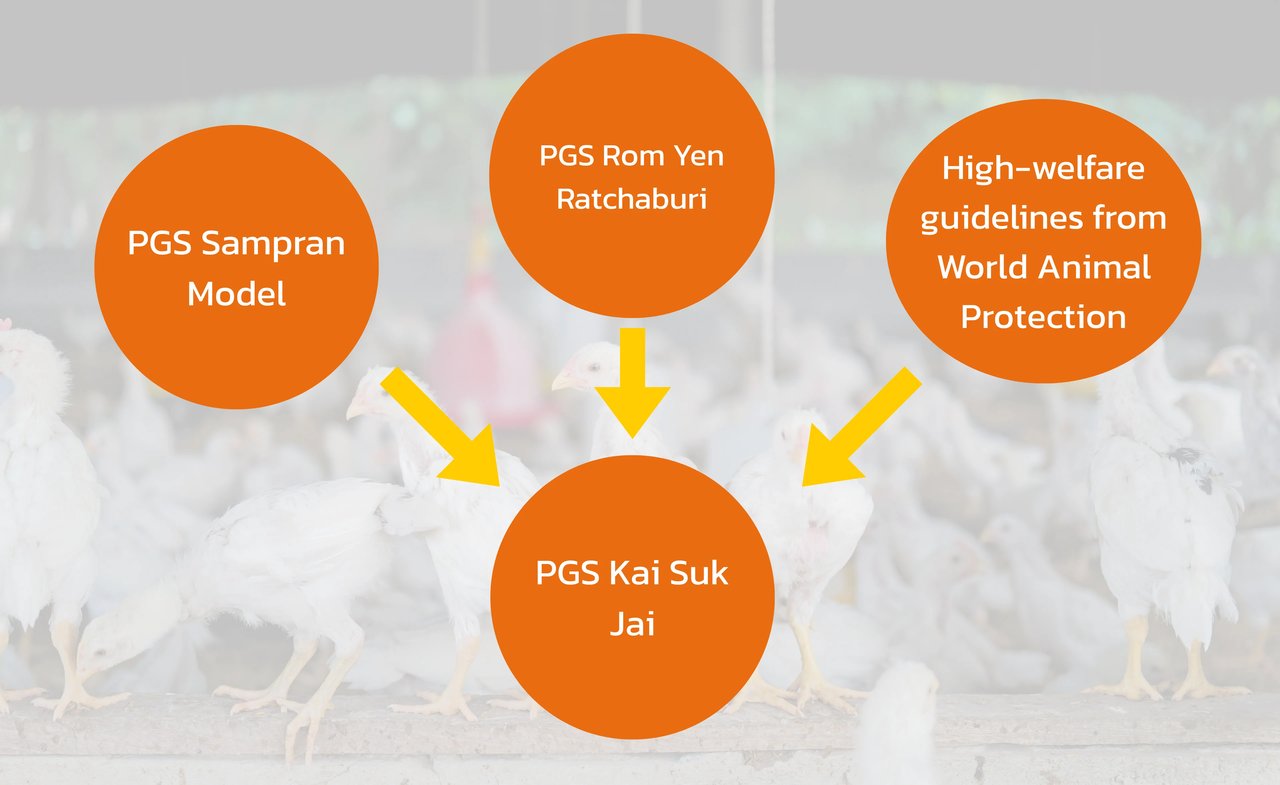
So how did the community create its standards for poultry farming? Initially, PGS members decided to draw knowledge from three distinct sources:
- A PGS with a proven track record. Patom looked at the PGS developed through the Sampran Model, which is managed by the Sangkom Sukjai (Happy Society Foundation). The foundations of the new system were based on a PGS system that had been tested, over many years, in practice, not just on paper.
- The advice of a local organic farmer. Varakorn Laohasereekul acted as an advisor to the project. He added the hands-on knowledge gained from PGS Rom Yen Ratchaburi, a system already in use across his own network. So the group could be confident that Kai Suk Jai PGS standards would work for local poultry farmers.
- Animal welfare guidelines from World Animal Protection. The group wanted their standards to be informed by an internationally recognised animal welfare standard. So they used World Animal Protection guidelines to ensure that the well-being of chickens sat at the heart of the initiative.
And what about the name: Kai Suk Jai?
The name of the PGS translates as Happy Chickens. But its meaning goes deeper. The phrase refers to a peace of mind that flows throughout the entire supply chain.
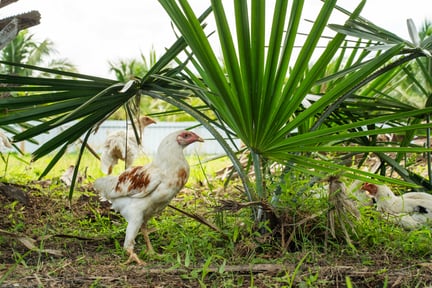
Chickens get to live in an environment that prioritises their welfare, where their natural behaviours are supported.
Farmers are supported by other PGS members. They know that if their products fall short of the standard, they can correct and improve. They don’t face penalties or punishments.
Consumers can buy and eat PGS-certified poultry products, knowing for sure where their food came from and how it was cared for.
Designing chicken welfare guidelines, based on observation and experience
When devising chicken welfare guidelines, the Kai Suk Jai PGS looks to the real-world behaviour of locally farmed chickens.
Does the chicken run towards people or away from them? Where does the chicken sleep? Where does the chicken scratch and forage?
For example, sometimes a chicken will ignore a recommended bedding material. They prefer to sleep somewhere else entirely.
Every behaviour and preference gives PGS members insight into what genuinely works for the birds. They can then devise standards through a process of observation, shared learning, and debate.
Varakorn explains it simply:
The name Kai Suk Jai makes it clear that we focus on the life of the chicken. We go back inside the chicken's heart and mind and look outward to see what they want. Then we design the whole environment around that: the people, the food, everything that lets them live the way they are happy to live.
The group also recommends raising Korat chickens, a semi-native breed developed in Thailand.
Korat chickens are naturally suited to the local climate, vegetation, and environment. So they need less medication and aren’t reliant on artificially-created living conditions.
Choosing this breed isn’t a case of taste or price. It’s a decision with chicken welfare at its core. When the chicken is suited to its environment, it’s much easier to meet its welfare needs.
An example of how chicken observation influences Kai Suk Jai standards
The international standard states that chickens require four square metres of outdoor space per bird.
Kai Suk Jai farmers observed the chickens in their care. They saw that the chickens tended to cluster and move together, rather than spread out over a wider area.
PGS members discussed and agreed that they could adjust standards in line with this finding.
They decided that the outdoor space available to the chickens should be twice the size of their sleeping area. This better matched the birds’ natural behaviour.
What does life look like for chickens under Kai Suk Jai?
The welfare standards outlined by the Kai Suk Jai PGS aren’t abstract commitments. They’re specific, verifiable practices that farmers can apply to their everyday work.
Here are a few examples drawn directly from Kai Suk Jai chicken welfare standards:
- Chickens should be free to express their natural behaviours. Farms have to provide enrichment such as sand baths, perches, and hay bales so that birds can peck, scratch, and nest. Without a way to express these natural instincts, chickens often peck at other members of their flock.
- Stocking density is designed around the chicken, not around the space. In sleeping areas, there can’t be more than ten birds per square metre. Outside, the birds need twice that space. This gives chickens the space to move, forage, and live together peacefully.
- Antibiotics can be used, but transparency is non-negotiable. The PGS doesn’t ban the use of antibiotics. But there are strict rules on how the chickens are to be treated with medication and the records farmers have to keep.
- Chickens have a right to natural light and darkness. Chickens must get at least eight hours of continuous light and six to eight hours of total darkness every day. This natural light cycle affects the physical and mental health of the birds.
These standards are not set in stone. Members of the PGS can revisit and revise them as the real-world impacts of their guidelines emerge.
Flexibility with guardrails: the Kai Suk Jai approach
The importance of flexibility
Most governmental farming standards are based on academic literature and international benchmarks.
They’re designed to cover all contexts. But guidelines are often too broad. So small-scale farmers struggle to apply them to their own farms.
Some guidelines are irrelevant to small-scale farms. Others create burdens that make it unsustainable for farmers to stick to the system in its entirety.
The Kai Suk Jai PGS is tailored to the local area and its farmers. It strips out unnecessary guidelines and keeps only what has been shown to work.
Flexibility is built into the system.
For example, farms in forested areas use the same PGS standards as farms on open land. But they apply those standards differently.
A farmer selling live chickens operates differently from a farmer who sells birds that have been slaughtered and processed. But the PGS still provides core principles that both farmers can stick to.
The PGS is also in a constant state of evolution. Members meet monthly to share insights, ask questions, and update guidelines where required.
When a majority of PGS members agree that an approach isn’t working, changes that benefit the chickens in their care can be made immediately. They don’t have to wait for approval from an external body.
The importance of guardrails
How does this flexibility work in practice? If guidelines can be adjusted at any time, does this undermine their impact?
The answer to these concerns is strong guardrails and a collective approach to changes.
So while the guidelines are flexible, there are several core principles that all Kai Suk Jai farmers stick to:
- Ensuring chickens are free from discomfort
- Consistently observing chickens to understand their behaviours and improve their welfare
- Transparent and minimal use of medication
- Food safety for the consumer
Where they relate to chicken welfare, these principles align with the Five Domains of Animal Welfare, an internationally recognised framework. They represent a line that everyone in the group has agreed not to cross.
Where changes to the guidelines are proposed, advisors, like Varakorn, play a key role.
Calling on an advisor’s expertise and years of experience, PGS members get help when deciding what changes can be made to suit each farm’s context.
For example, if weather conditions in a given week increase the risk that disease will spread, temporarily keeping the chickens inside isn’t just more convenient for the farmer. It’s also better for the birds.
Chickens living under Kai Suk Jai standards don’t necessarily live in identical settings. Instead, they live in homes that can be adapted to best meet their needs.
You can make a difference for vulnerable animals
Donate now
When you make a donation, you’ll join a passionate group of supporters who are determined to change the world for animals. We're fighting animal cruelty wherever we find it — are you with us?
Click to donateThe role of consumers in Kai Suk Jai
You don’t need to be a farmer to participate in Kai Suk Jai. The PGS welcomes input from everyone involved in the food system, including government agencies, universities, private businesses, and consumers.
People can contribute their own perspectives to support and shape the system. And compared to other food systems, the consumer takes on a much more important role.
Instead of sitting at the far end of the supply chain, as recipients, Kai Suk Jai creates space for consumers to shape the kind of food system they want to see.
They can say what breeds of chickens they prefer. They can call for changes in how animals are raised. They can request community initiatives, like farm learning sessions for children.
Ultimately, the PGS has ambitions that extend beyond selling chicken at a better price.
- It’s about ensuring farmers get a stable income, and can be genuinely proud of the animals they raise.
- It’s about ensuring consumers can trace and influence the origin of the food products they buy.
- It’s about building trust throughout the market, so low prices aren’t the priority.
The future of Kai Suk Jai
Everything tends to deteriorate over time. What we have to protect is not the document, but the integrity of every person in the group.
To ensure a long and healthy future for Kai Suk Jai, the group is currently focused on three main tasks:
- Sustaining the PGS. The team behind Kai Suk Jai PGS know that building the system is only part of the work. Maintaining a spirit of collaboration, the willingness to be observed by peers, and the discipline to stick to core principles, is an equally important task.
- Raising awareness with consumers. Most consumers are not yet familiar with the PGS. All they see is the PGS logo on chicken product packaging — they may not understand what that mark means. The group is committed to building trust and understanding among consumers.
- Keeping farmers in the driving seat. Patom Organic Living plays an advisory role. But the PGS belongs to farmers. Patom must maintain the balance between guidance and overstepping, so they support rather than direct.
By continually interrogating the approach of the PGS, and being honest about what it does well and what could be improved, members hope to make the system sustainable. Because the Kai Suk Jai PGS was not created as a certification label or a marketing claim.
Instead, it’s a living commitment, made by a group of farmers who decided that chickens and consumers deserve better.
Kai Suk Jai and World Animal Protection
Through the Investing in Others programme, World Animal Protection proudly supports Patom Organic Living and the farmers behind Kai Suk Jai PGS.
The group is showing us what can be achieved when animal welfare is placed at the heart of a food system. Not as a top-down regulation, but as a shared commitment, developed collectively from the ground up.
Related content
The Pecking Order 2025
No Future For Factory Farming
Europe's largest fast-food and restaurant companies are at risk of failing their chicken welfare commitments, according to The Pecking Order 2025.
World Farmed Animals Day
Animal Awareness Days
Celebrate World Farmed Animals Day on 2nd October and discover its significance, learn about factory farming, and explore ways to protect sentient beings.
High animal welfare on farms
No future for factory farming
Find out how we work with the food industry to improve farm animal welfare and keep animals in an environment where they can benefit from a life worth living